Fill Out Your Wisconsin Executive Summary Template
The Wisconsin Executive Summary form serves as a vital tool for condominium associations, providing essential information to prospective buyers. This form is designed to be user-friendly, featuring a fill-in-the-blank and checkbox format that simplifies the process of gathering important details about the condominium. It is crucial that only authorized individuals, such as board members, property managers, or attorneys, complete this form, as real estate licensees and unit owners should refrain from doing so. The Executive Summary addresses various aspects of condominium living, including management structure, parking arrangements, pet policies, and maintenance responsibilities. Each section prompts the user to provide clear and concise answers, while also allowing references to specific sections of the condominium documents for more detailed information. Legal requirements dictate that the Executive Summary must accompany the condominium disclosure materials and be attached to the real estate condition report provided to potential buyers. For condominiums created after May 1, 2005, the use of this form is mandatory in relevant transactions, ensuring that buyers receive up-to-date and comprehensive information about their prospective home. By following these guidelines, condominium associations can effectively communicate essential details to buyers, helping them make informed decisions.
Form Example

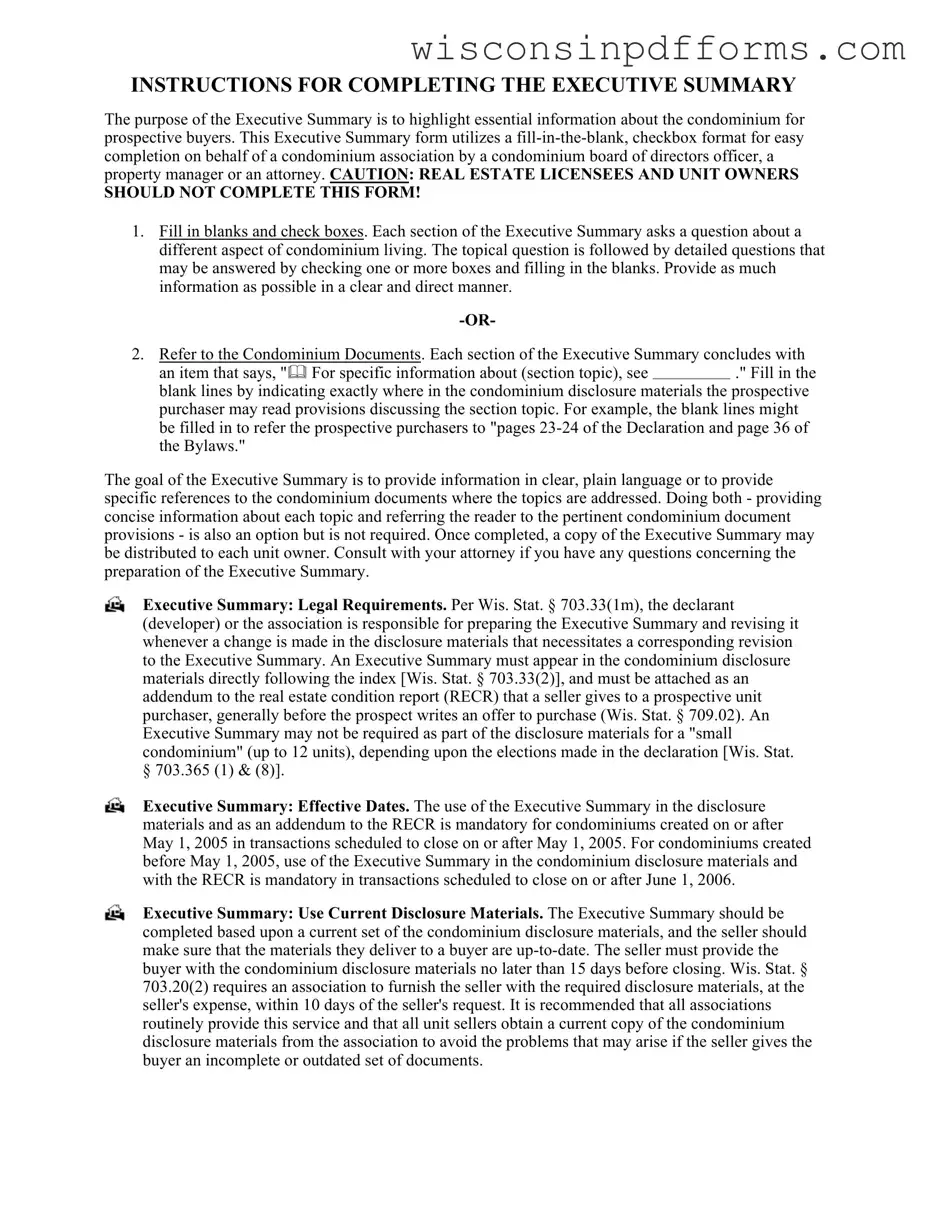
INSTRUCTIONS FOR COMPLETING THE EXECUTIVE SUMMARY
The purpose of the Executive Summary is to highlight essential information about the condominium for prospective buyers. This Executive Summary form utilizes a
SHOULD NOT COMPLETE THIS FORM!
1.Fill in blanks and check boxes. Each section of the Executive Summary asks a question about a different aspect of condominium living. The topical question is followed by detailed questions that may be answered by checking one or more boxes and filling in the blanks. Provide as much information as possible in a clear and direct manner.
2. Refer to the Condominium Documents. Each section of the Executive Summary concludes with
an item that says, " For specific information about (section topic), see ." Fill in the blank lines by indicating exactly where in the condominium disclosure materials the prospective purchaser may read provisions discussing the section topic. For example, the blank lines might be filled in to refer the prospective purchasers to "pages
The goal of the Executive Summary is to provide information in clear, plain language or to provide specific references to the condominium documents where the topics are addressed. Doing both - providing concise information about each topic and referring the reader to the pertinent condominium document provisions - is also an option but is not required. Once completed, a copy of the Executive Summary may be distributed to each unit owner. Consult with your attorney if you have any questions concerning the preparation of the Executive Summary.
Executive Summary: Legal Requirements. Per Wis. Stat. § 703.33(1m), the declarant (developer) or the association is responsible for preparing the Executive Summary and revising it whenever a change is made in the disclosure materials that necessitates a corresponding revision to the Executive Summary. An Executive Summary must appear in the condominium disclosure materials directly following the index [Wis. Stat. § 703.33(2)], and must be attached as an addendum to the real estate condition report (RECR) that a seller gives to a prospective unit purchaser, generally before the prospect writes an offer to purchase (Wis. Stat. § 709.02). An Executive Summary may not be required as part of the disclosure materials for a "small condominium" (up to 12 units), depending upon the elections made in the declaration [Wis. Stat. § 703.365 (1) & (8)].
Executive Summary: Effective Dates. The use of the Executive Summary in the disclosure materials and as an addendum to the RECR is mandatory for condominiums created on or after May 1, 2005 in transactions scheduled to close on or after May 1, 2005. For condominiums created before May 1, 2005, use of the Executive Summary in the condominium disclosure materials and with the RECR is mandatory in transactions scheduled to close on or after June 1, 2006.
Executive Summary: Use Current Disclosure Materials. The Executive Summary should be completed based upon a current set of the condominium disclosure materials, and the seller should make sure that the materials they deliver to a buyer are

EXECUTIVE SUMMARY
Page 1 of 3
This Executive Summary highlights some of the information that prospective condominium buyers are most interested in learning, as well as some of the information that they should consider when contemplating the purchase of a condominium unit. The following sections either briefly summarize pertinent information by answering the questions asked, direct prospective buyers to specific sections of the condominium disclosure materials that discuss each topic in detail (at the icon), or may be completed to both summarize the information and refer to the condominium documents. This summary, however, is not intended to replace the buyer's review of the condominium declaration, bylaws and other condominium disclosure materials nor is it a substitute for a professional review of the condominium documents.
Condominium Name: |
|
|
|
How is the condominium association managed? |
|
||
What is the name of the condominium association? |
|
||
What is the association's mailing address? |
|
||
How is the association managed? |
By the unit owners |
By a management agent or |
|
company |
By the declarant (developer) or the declarant's management company |
||
 Whom should I contact for more information about the condominium and the association?
(management agent/company or other available contact person)
 What is the address, phone number, fax number, web site &
For specific information about the management of this association, see
What are the parking arrangements at this condominium? |
|
|
|
|
|||||||||||||
Number of parking spaces assigned to each unit: |
|
|
|
How many Outside? |
|
|
How many Inside? |
|
|||||||||
Common element |
Limited common element |
|
|
Included as part of the unit |
|
Separate non- |
|||||||||||
voting units |
|
Depends on individual transaction |
[check all that apply] |
|
|
|
|
||||||||||
Do I have to pay any extra parking fees (include separate maintenance charges, if any)? |
No |
Yes, in |
|||||||||||||||
the amount of $ |
|
|
|
per |
|
|
|
Other (specify): |
|
|
|
|
|
||||
Are parking assignments reserved or designated on the plat or in the condominium documents? |
|
|
|||||||||||||||
No |
Yes - Where? |
|
|
|
|
|
|
|
|
Are parking spaces assigned to a |
|||||||
unit by deed? |
No |
Yes Can parking spaces be transferred between unit owners? |
No |
Yes |
|||||||||||||
What parking is available for visitors? |
|
|
|
|
|
|
|
|
|
|
|
||||||
What are the parking restrictions at this condominium? |
|
|
|
|
|
||||||||||||
For specific information about parking at this condominium, see
May I have any pets at this condominium?
No |
Yes - What kinds of pets are allowed? |
 What are some of the major restrictions and limitations on pets?
For specific information about the condominium pet rules, see

May I rent my condominium unit?
No 
 Yes - What are the major limitations and restrictions on unit rentals?
For specific information about renting units at this condominium, see
Page 2 of 3
Does this condominium have any special amenities and features?
No 
 Yes - What are the major amenities and features?
 Are unit owners obligated to join or make additional payments for any amenity associated with the
condominium, such as an athletic club or golf course? |
No |
Yes - What is the cost? $ |
For specific information about special amenities, see
What are my maintenance and repair responsibilities for my unit?
 A Unit Owner must maintain and repair
For specific information about unit maintenance and repairs, see
Who is responsible for maintaining, repairing and replacing the common elements and limited common elements?
 Common element maintenance, repair and replacement is performed as follows:
How are repairs and replacements of the common elements funded? |
Unit owner assessments Reserve |
|||
funds |
Both |
Other (specify): |
|
|
 Limited common element maintenance, repairs and replacement is performed as follows:
 How are repairs and replacements of the limited common elements funded?
Reserve funds |
Both |
Other (specify): |
For specific information about common element maintenance, repairs and replacements see
Does the condominium association maintain reserve funds for the repair and replacement of the common elements? 
 Yes
Yes 
 No Is there a Statutory Reserve Account (*see note on page 3*)?
 Yes
Yes 
 No
No
For specific information about this condominium's reserve funds for repairs and replacements, see
How are condominium fees paid for on the developer's new units that have not yet been sold to a purchaser?
 Is the developer's obligation to pay fees for unsold units different than the obligation of new unit purchasers to pay fees on their units?
 Not applicable (no
 No
No 
 Yes - In what way?

Page 3 of 3
 Are there any special provisions for the payment of assessment fees that apply only during the developer control period?
 No
No 
 Yes - Describe these provisions:
For specific information about condominium fees during the developer control period, see
Has the declarant (developer) reserved the right to expand this condominium in the future?


 No
No 
 Yes - How many additional units may be added through expansion?units
  When does the expansion period end?
 Who will manage the condominium during the expansion period?
For specific information about condominium expansion plans, see
May I alter my unit or enclose any limited common elements?
 Describe the rules, restrictions and procedures for altering a unit:
 Describe the rules, restrictions and procedures for enclosing limited common elements:
For specific information about unit alterations and limited common element enclosures, see
Can any of the condominium materials be amended in a way that might affect my rights and responsibilities?
 Yes, Wisconsin law allows the unit owners to amend the condominium declaration, bylaws and other condominium documents if the required votes are obtained. Some of these changes may alter your legal rights and responsibilities with regard to your condominium unit.
For specific information about condominium document amendment procedures and requirements, see
Other restrictions or features (optional):
This Executive Summary was prepared on |
|
|
(insert date) |
|
by |
|
|
(state name and title or position). |
|
*Note: A "Statutory Reserve Account" is a specific type of reserve account established under Wis. Stat. § 703.163 to be used for the repair and replacement of the common elements in a residential condominium (optional for a small condominium with less than 13 units or a
This Executive Summary was developed and distributed by the Wisconsin REALTORS® Association (2004).
Drafted by: Attorneys Debra Peterson Conrad (WRA), Jonathan B. Levine, and Lisa M. Pardon (Brennan, Steil & Basting, S.C.)
Document Specs
| Fact Name | Description |
|---|---|
| Purpose | The Executive Summary highlights essential information about the condominium for prospective buyers. |
| Completion Responsibility | This form should be completed by a condominium board officer, property manager, or attorney, not by real estate licensees or unit owners. |
| Governing Law | Wis. Stat. § 703.33(1m) mandates that the declarant or association prepares and revises the Executive Summary as needed. |
| Mandatory Inclusion | The Executive Summary must appear in condominium disclosure materials and as an addendum to the real estate condition report (RECR). |
| Effective Dates | For condominiums created on or after May 1, 2005, the Executive Summary is mandatory for transactions closing on or after that date. |
| Disclosure Materials | Sellers must provide buyers with current condominium disclosure materials at least 15 days before closing. |
| Statutory Reserve Account | A "Statutory Reserve Account" is required under Wis. Stat. § 703.163 for repair and replacement of common elements, with certain exceptions. |
Popular PDF Forms
Check Homestead Status Wisconsin - The incorporation of a section for adjustments based on qualifying dependents illustrates the form's comprehensive approach to evaluating household need.
Wisconsin Uniform Building Permit Application - A comprehensive tool for aligning construction practices with state statutes, making it a critical document for any construction or renovation project in Wisconsin.
For those navigating a divorce, understanding the importance of a thorough Divorce Settlement Agreement template can significantly ease the process. Consider utilizing a resource that provides a fillable format to ensure all necessary terms are captured, such as a comprehensive Divorce Settlement Agreement outline.
Dcf Wisconsin - Specifies the address to which the completed form should be faxed for processing.